
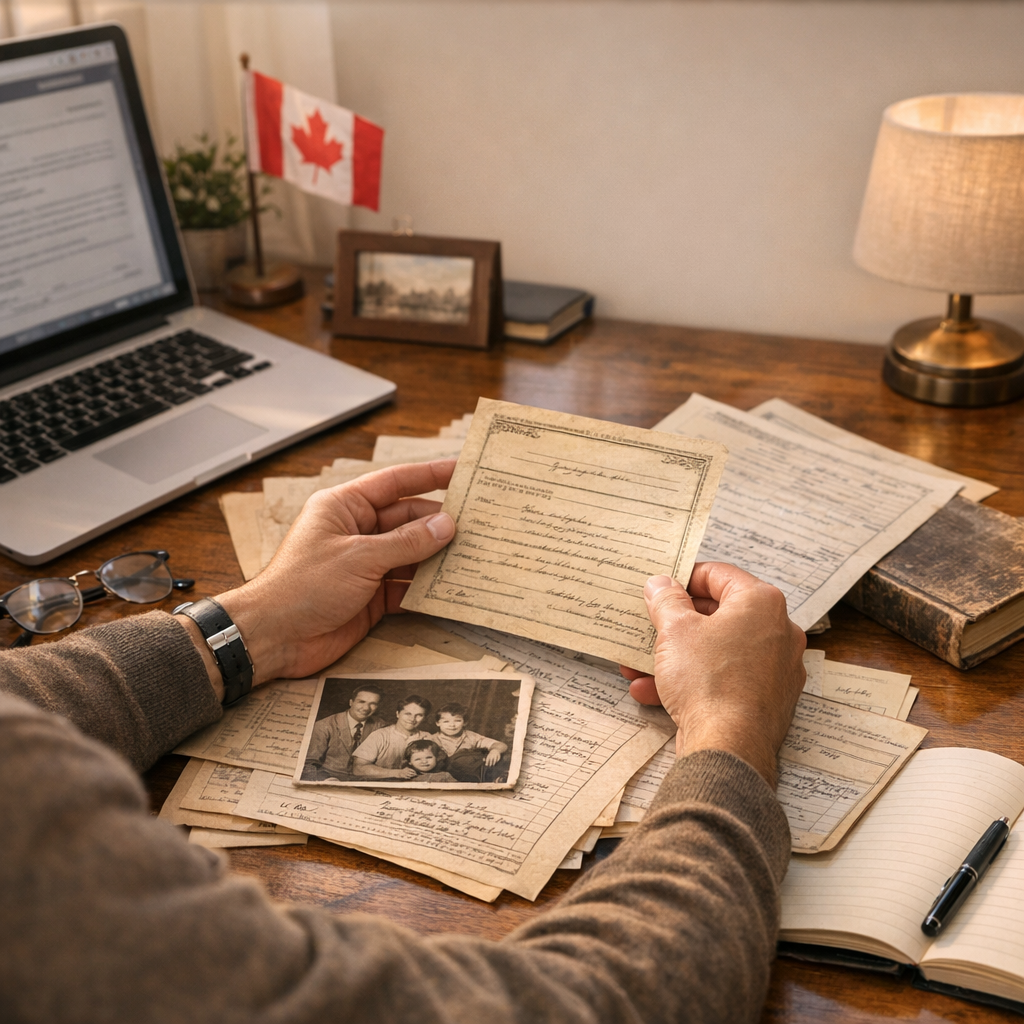
If you are trying to prove Canadian citizenship by descent, the hardest part is often not the application itself, but the records search. When family history spans several generations, missing documents can slow the process.
What this update means
The key point is that applicants may need to show a documented, direct, and unbroken line from a Canadian ancestor to themselves when applying for proof of Canadian citizenship. In practice, that can mean collecting birth, marriage, death, census, immigration, and name-change records across multiple countries and time periods.
The source update highlights genealogy tools that can help people trace ancestors when paper records are incomplete or difficult to locate. While these tools can be useful, they do not replace official evidence. You still need documents that support your citizenship claim and meet IRCC’s requirements.
Why records searches can become difficult
Family history research often runs into the same problems:
- Names were spelled differently in older records
- People changed surnames after marriage or immigration
- Records were lost, damaged, or never digitized
- Families moved across borders or provinces
- Older documents may use different dates or formats
These issues do not automatically prevent a claim, but they can make it harder to connect each generation clearly.
Practical tools that may help
1. Genealogy websites and archives
Large genealogy platforms and archive collections can help you search census records, passenger lists, vital records, and family trees. These are often the first place to look when you need to identify names, dates, and locations.
2. Provincial and national archives
Government archives, libraries, and historical societies may hold older birth, marriage, death, and immigration records that are not easy to find elsewhere.
3. Local church and cemetery records
In some cases, church registers, burial records, and cemetery databases can help confirm family links when civil records are missing or incomplete.
4. Newspaper archives and obituaries
Historical newspapers can sometimes provide useful clues about family relationships, residence history, and name changes.
5. Family documents and personal records
Old passports, letters, family Bibles, school records, and photographs may help support a timeline, especially when paired with official documents.
Possible impact
For people exploring citizenship by descent, better record tracing can make it easier to identify whether a claim may exist and what documents are still missing. It may also help applicants prepare a more organized file before requesting proof of citizenship.
That said, not every family history search will lead to a complete documentary trail. Some applicants may still need to request replacement records, use alternate evidence, or get help reviewing whether the available documents are enough for the application.
What applicants should do next
- Start with the most recent generation and work backward one document at a time
- Collect full legal names, dates, and places for each family member in the line of descent
- Look for both civil records and supporting records if a document is missing
- Keep copies of every source, including screenshots and archive references
- Check whether any citizenship transmission rules or historical changes may affect your case
- Review the current IRCC instructions before applying for proof of citizenship
If your family history is complex, a structured document review can help you understand whether the lineage is complete or where the gaps are.
FAQ
Do genealogy tools prove Canadian citizenship by themselves?
No. They can help you find records and build a family history, but you still need official or supporting documents for the citizenship application.
What kind of records are most useful?
Birth, marriage, and death certificates are often the most important. Depending on the case, census records, immigration records, and name-change documents may also help.
What if one record is missing?
A missing record does not always end the search. You may be able to use alternate documents, but the evidence still needs to support an unbroken lineage.
Should I apply as soon as I find one Canadian ancestor?
Not necessarily. It is important to confirm whether the full line of descent is documented and whether the citizenship rules apply to your situation.
Conclusion
Tracing Canadian citizenship by descent often requires patience, careful recordkeeping, and a step-by-step approach. Genealogy tools can help you move past dead ends, but the final focus should remain on building a clear documentary chain.
Immigration policies and procedures can change. This article is for general information only and does not constitute legal advice.
If you are unsure whether your records are enough, consider getting professional guidance before submitting a proof of citizenship application.